Sale!

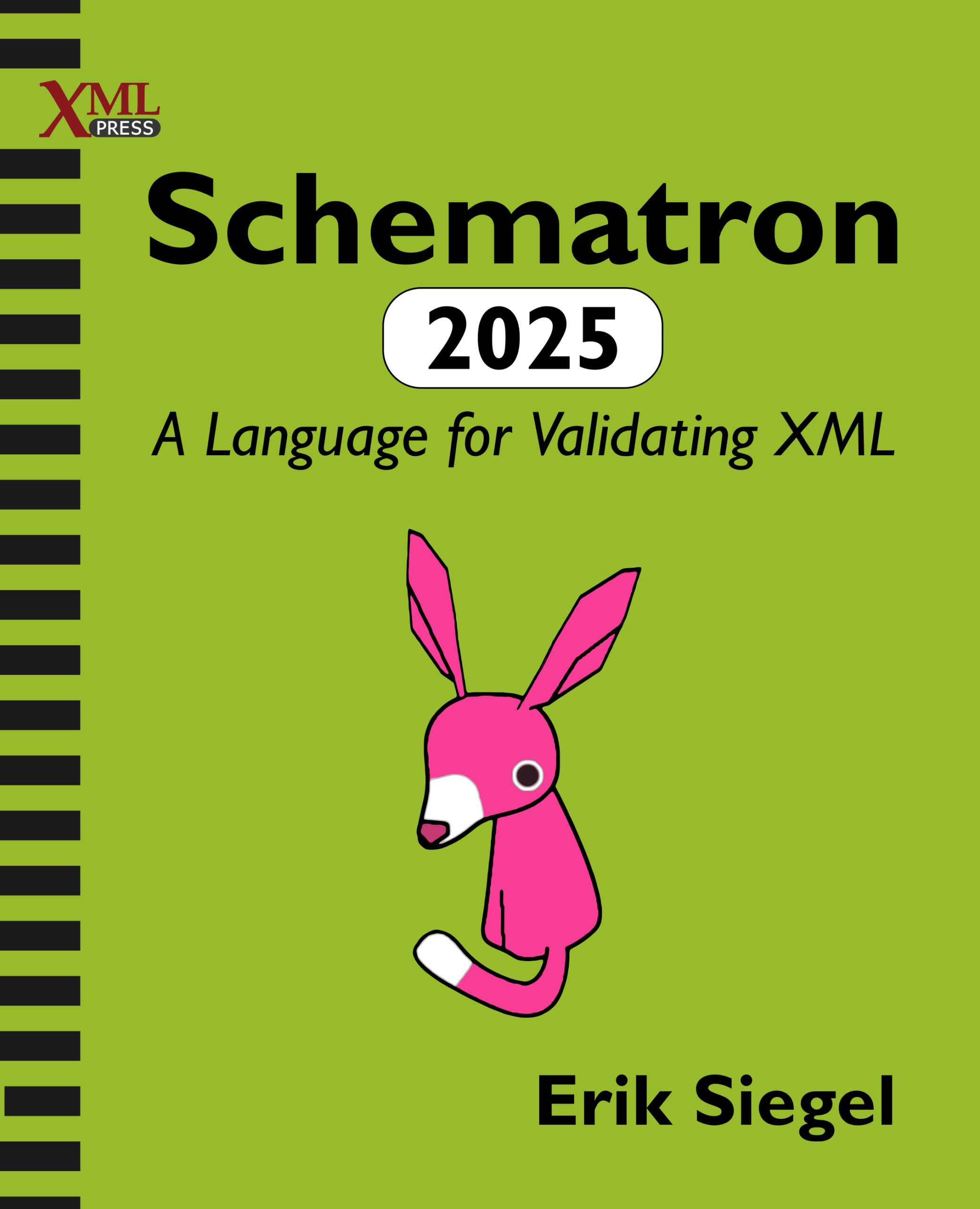
Schematron 2025: A Language for Validating XML

Original price was: $29.95.Current price is: $24.95.

by Erik Siegel

Schematron 2025 is a validation language that checks XML documents against business rules. It extends the validation provided by languages such as Document Type Definitions (DTD), W3C XML Schema, and RELAX NG, giving you the ability to check your XML documents for compliance with rules that can be difficult, if not impossible, to check with the other validation languages. This book describes the Schematron 2025 language in detail, including changes and additions since the 2020 edition of Schematron.

SKU: 9781937434946 Category: Tags: , , , ,

Description

Schematron 2025 is a validation language that checks XML documents against business rules. Based on the ISO Schematron specification from 2025, it extends the validation provided by XML schema languages such as Document Type Definitions (DTD), W3C XML Schema, and RELAX NG to check XML documents for compliance with rules that can be difficult, if not impossible, to check with the other validation languages.

Schematron 2025: A Language for Validating XML explains the language in detail and clearly outlines the differences between Schematron 2025 and the previous edition, covered in Erik Siegel’s previous book: Schematron: A Language for Validating XML.
Contents

  • Introduction: introduces Schematron 2025 and provides background.
  • Schematron in context: provides an overview of XML validation, the main languages currently used to validate XML, and introduces Schematron as an important part of the validation tool set.
  • Applying Schematron: describes how to create and validate using Schematron and introduces the most commonly used processors for Schematron.
  • Schematron basics: describes how to set up a Schematron schema, and introduces the most frequently used constructs in Schematron.
  • Advanced Schematron: covers advanced Schematron features such as localization, abstract rules, pattern reuse, and more.
  • Query language binding and using XSLT: describes how to use different query languages, as well as XSLT, as part of a Schematron schema.
  • Additional features: covers lesser used features such as message text markup, flags, properties, structured comments, and more.
  • Schematron examples and recipes: examples of how to use Schematron for common situations, such as validating schemas, checking for multiple id references, validating processing instructions and comments, and detecting incorrect nesting.
  • XPath technology primer: introduces XPath, which is used extensively in Schematron, including features such as tree navigation, special operators, expressions, and more.
  • An introduction to namespaces: describes XML namespaces and how Schematron treats namespaces.
  • Schematron reference: a detailed reference to the Schematron 2025 language.
  • SVRL reference: a detailed reference to the Schematron Validation Reporting Language (SVRL), which is an XML-based schema used by Schematron processors to produce output that can be post-processed by another program.
  • Schematron QuickFix: a Schematron extension that embeds suggested fixes for errors. A QuickFix-aware IDE can use this information to offer a user the opportunity for the IDE to immediately apply a fix to document being validated.
  • Additional resources: a bibliography of resources for further exploration.
  • Changes in Schematron 2025: a comprehensive list of updates and new features introduced in Schematron 2025.

About the Author

Erik Siegel is a content engineer and XML specialist who runs Xatapult consultancy in the Netherlands. He specializes in content design and conversions, XML Schemas and transformations, eXist and XProc applications, and XML-related training.

He is the author of XProc 3.0 Programmer’s Guide, also from XML Press.

Reviews

There are no reviews yet.

Only logged in customers who have purchased this product may leave a review.

About the Store

We offer non-DRM ebook editions for XML Press publications as a two-format bundle:

  • ePub
  • PDF

Once you purchase a bundle, you will receive email with a download link. Print editions and single-format ebook editions of our books are available from most online book retailers. * NOTE: Some of our earlier editions also include a MOBI (.mobi) format version of the book. This format is provided with books published before 2025.  For the best reading experience with newer Kindles, we recommend that you use the email to Kindle feature and send the epub version to your Kindle. If you need the .mobi format for a newer book, send email to orders@xmlpress.net, and we can provide a usable, but not ideal, .mobi file.